(Back to) the Basics pt II: Hold that Baby!

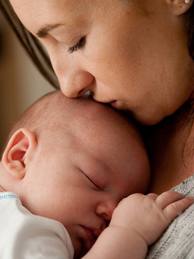
Today, I wanted to take a moment, or a dozen, to say a little more about the simple and vital act of holding our babies — especially those newborns. You may remember from the last post, I mentioned “the fourth trimester” — the increasingly common phrase for the final gestational development an infant undergoes in the few months immediately after birth — I’ll say a little more about that, too. And just for fun, I’ll throw in a couple prophecies of “super-human” capabilities, as well. To those of you parenting “over-achievers” who have studied-up on infant brain development and/or are Attachment pros — please bear with me if you find yourself yawning. You may feel free to just gloss over the stuff you know, and seek out the nuggets of deeper understanding regarding this significant and necessary concept in Attachment theory. To those of you just getting your parenting bearings — even if it takes you a couple days to get through it all – don’t miss a word of what follows.

First, you should know, the design of which you are a part is flawlessYou as parent with your baby are honed to nothing short of a biological perfection. Your body and your brain have and/or are currently developing all the right skills, endurance, pheromonal communications, hormonal fluxes, micro- and macro-physical responses, nervous system connections, and intuitions necessary to make you a fine parent. You’re built to do this. And, frankly let’s face it, the process of building a baby, birthing it, and nurturing it to adulthood, is ridiculously common place. Don’t get me wrong, our own babies are *miracles* — but babies, in general, well, they’re a dime a dozen, aren’t they? In fact, raising a baby to being old enough to fend for itself is so commonplace that even the simplest animals have no trouble doing it at all.

But humans are not ”the simplest animals”, you say. As a species, we just happen to be so highly evolved that we are (as far as we know) unparalleled by any creature on the Earth. Of course, we are the planet’s best known fools as well, but that’s another story… In the course of our evolution, humanity, and more specifically the human brain, has reached a developmental state such that we are capable of participating in relationship to life, the planet, and each other in a manner and to a degree that is richer and more complete than any other animal on the planet, perhaps ever. This also happens to make us dependent on our parents and care-givers for much much longer than our cohabitants. We humans are among the slowest children on the development block. Notably, we are accompanied by our closest primate relatives, the chimps and apes, who carry their babies until about 3 or 4, nurturing them until almost 7; and elephants who nurse exclusively until the offspring are between 3 and 5, and continues nursing sometimes until the child is 10.

So what’s this all about, then — why  are we so slow to “get going”, and just what’s happening in there?! And, most importantly, how do we help it all go smoothly?

The answer goes immediately back to that amazing brain of ours. It’s a work of art no less magnificent than humanity itself. It has been evolving for so long and has become such a specialized instrument, and such a complex part of the body that it not only carries “programing” within it (purely unconsciously) helping us continuously, including when it’s our turn to be parents; but more importantly for the moment, it also carries a program to help the infant develop, and can even prepare itself during its development for higher and higher capabilities depending on how it is nurtured through the maturation process. The human brain itself is actually working through us to develop it’s own child (the next generation’s brain), just as we are working to assist our children in their development.

It’s a bit of an alien concept, I know, but there’s good reason to believe that awareness is developing itself, right alongside of humanity’s evolution, and via each of our own individual paths throughout life, and particularly through parent-and-childhood. I don’t mean to get too lofty here. The bottom line is this — our brains are helping us, both the parents and the babies, and our brains “know” a great deal more than we do. We can choose to trust in it or not as we please, but if we want to give our children the best that we can give them, then we would do well to at least honour the brain, and yield to it’s processes of development.

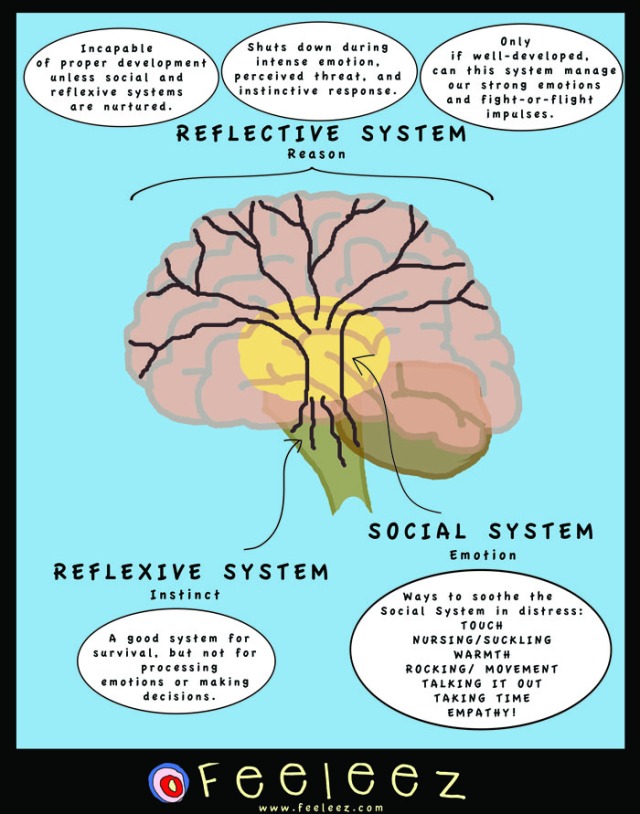
Now, as most high school students could tell you (if they would talk to you) — as we humans evolved from earlier primates, we grew a lot, and our brains more than doubled in size; in fact, some theorists hypothesize that our bodies have grown so much since our early beginnings, just to be able to feed our swelling brains. As our brains got bigger, they also got a lot more complex, overlaying older, simpler structures with new, more advanced biological technology. We also added and expanded a number of new features as we grew our grey matter, most notably, the gigantic frontal lobe. Compared with the rest of the animal kingdom, we’re like those bubble-brained aliens on Star Trek when it comes to frontal lobes. Chimps and apes’ brains are about 7% frontal lobe; in the human brain it’s nearly 17%. And as it turns out, that frontal lobe is one interesting bit of brain. It’s where most of our higher thinking happens, and is vitally involved every time we make a decision; it’s generally considered the place from which we moderate our own behavior, express our personalities, and process social dynamics; and some say it carries the seat of awareness itself. The frontal lobe additionally has evolved to make excellent use of its relationships with the other parts of the brain; and truthfully the entire development of the human brain has hinged on the process of making excellent use of what was already there in the “lower” forms of pre-hominid brains.

Think of it this way — if brains in general are machines, then the earliest models of brains were/are wind-up toys: they’re set in motion and just perpetuate repetitiously until they wind down (usually immediately following procreation). Reptile brains are calculators: they perform a prescribed set of specific functions only, and very little if anything outside of those parameters. Mammal brains get into higher and higher forms of computing devices, all the way up to humans, which are a bit more advanced than your standard desktop personal computer. And as mentioned above, part of what makes the human brain-computer so powerful is that it has carefully maintained and refined the best elements of the wind-up toys, the calculators, and the simple Commodore 64′s that preceded it evolutionarily. We’ve got hardware, and hardwired programs that run, whether we tend to them or not; and we’ve got additional programs that come added in (on arrival) and that can expand as we use them; and then, depending on the software that is downloaded onto our hard drives, we run more and more varying and coalescing programs throughout our lives. If we get low-grade software, or if it doesn’t get downloaded properly, or our hard drives get hacked by destructive programming, or the like, then our capacity may be limited, our programs may run into errors that force shut downs, or our programs may conflict, etc., etc.. Whereas, if we get top-of-the-line software, and it’s loaded with care, and our security systems are in place to protect our processors, then we are capable of running programs like Mozart 2.0, or Einstein 3.1, or Gandhi OSX.

“That’s not all [our brains have evolved], no that’s not all!”, but it does begin to explain why our brains know more than we do about being a parent, as well as why we take so  much longer to grow up.

In terms of development, and raising our little infants, there’s two important things I don’t want to pass over: 1) the brain has swelled in humans to such an extent, that we not only have a longer developmental period of dependency, but we are also all born “early” just so that we can get our big heads out of the birth canal; and 2) as intimated above, the brain is so highly developed, and has such potential that even the process of it’s development develops according to the environment. These two points are vital to understand if we are to offer our children all that we can for their best possible development. And both absolutely require that we hold our babies.

First things first — babies are born before their skulls harden. In fact, the plates of bone in the skull aren’t even finished growing in size, let alone the fact that they are freely moving plates basically anchored-but-afloat above the brain. These plates actually slide over one another slightly during birth — which accounts for the pointy crown of most vaginally-delivered newborns — then the plates begin to settle into place shortly after birth, and close in the seams and gaps (those “soft spots”) over time. Let’s be clear about this — the head isn’t done yet when the baby comes out. So it’s really important to keep it close to a soft Mama or Papa, cushioned from the sharp-pointy and hard-flat world for at least those first few months. In fact, the sheer perfection created during the development of our species has arranged it such that, the baby’s skull starts to be hard enough to handle the world a little more just as the baby is starting to be able to hold her big ole head up, and the skull gets harder still just in time for baby’s later motor-development as well. But in that first short period, the baby is ready (physically and mentally) only to make the immense transition from his previous (entire!) life being one way to his post-natal life being totally different from that womb-bliss existence. The first three months, you are just grounding the baby in life outside the womb. I say more about that process in a moment, but I just want that fact to be set in stone for you first. The fourth trimester is just about this “life after birth” transition. That’s it.

Secondly, if we want the baby’s brain to develop to it’s fullest potential, we must honour its ideal process. We have to give it all that it needs at each stage, or else the brain hedges it’s bets, and begins to rewire it’s process. The brain figures, and perhaps rightly so, that if it isn’t going to get it’s optimal developmental environment, it’ll adapt and change it’s strategies for better survival and development given the actual environs. That drive, to develop no matter what, is why we as a species are even here at all. But it’s not how we thrive, nor how we bring our latent capabilities to fruit. In order to claim the promise of the human brain, we parents must spend those first months tending to the infant’s transition from in Mama’s womb to on Mama’s chest, and then onto Mama and Papa’s hips (backs, etc.), and then holding onto Mama and Papa’s hands, and so on. And the way the brain needs us to do that is by continually making each chapter of the transition feel safe.

That’s all there is to it, really. But it’s so vital to attend to this one part properly that I would rate it as the single most important portion of all the parenting we will do of our children throughout our lives together. We can all live without childhood going ideally, but none of us would be alive if we didn’t get that safe feeling at least some of the time. The sense of security that the brain needs to develop has a spectrum of thresholds: without any sense of safety a newborn will die (from a condition cryptically know as “failure to thrive”); with a minimum experience of security, babies will live but be vastly under-developed and/or psychologically dissociated; at a higher amount of security, as most of us have had, development proceeds largely unimpeded, but with less vigor than that of which it is capable, babies grow into under- or mis-developed adults with all the physical, mental, and emotional atrophies and dysfunction that are so prevalent today. Of course, there is a higher threshold, still, experienced by precious few, wherein the infant and growing child is made to feel ultimately secure, comfortably safe, and unconditionally loved — in short, as though he belongs – at which point the brain, nervous system, and body are fully signaled and empowered to develop, absorb, learn, and create in ways that most of us can barely imagine today.

The process of keeping the brain steeped in a tender sense of security so that it will unfurl its wings wide, and truly embrace the world, and flourish in it, is indeed fairly simple, generally speaking. The specifics, however, can get inventive, and could be hyper-idiosyncratic. That is, we can pick from innumerable ways to help our newborns transition — the sky’s the limit — so long as we are willing to defer to what works for the child — and that means, each child, regardless of what worked for her sibling or your best friend’s baby. I mentioned some ideas in the last post, but essentially, beginning in the early months of pregnancy, you want to talk to your baby, and play semi-quiet music to the belly (that you’ll play again once she is out), let Mama’s belly get some sunlight (that baby will be able to perceive from in the womb as well), etc., etc..

It’s also important to give birth as gently as possible, remembering that you are the giver of your child’s only birth. Be kind to yourself, but remember that this process isn’t just about you surviving getting your baby out, it’s also about the process the baby needs to come out feeling safe. I happen to be of the opinion that the trip down the birth canal, and the requisite full-body every-inch bear-hug the baby gets on the way, precipitates the baby’s first neurological leap. If it goes according to plan, the baby gets a massive influx of physical experience and information unlike anything he’s ever witnessed, which clearly marks a break in the baby’s old life, and shocks him into a new kind of awareness. This is accompanied by  a flood of adrenaline, which is a good internal drug for “brain-learning” (as opposed to intentional, intellectual-learning) as well as “fight or flight” reactions, but is only of service to him if the baby gets to calm down from the adrenaline rush in order to assimilate the new information and feel safe enough to continue to be open to further stimulus.

Most of us, Boomers and Generation X-ers, got stiffed on this part. Most of us were born, high-density capitalistic-production style. Our mothers were often drugged during labor, and we came out stoned, and unable to recognize our mothers as human babies are normally able to in the moments after birth (both Mama’s smell and sounds, as well as her visage); and even if we could have connected with our mothers through the narcotic haze, we were summarily whisked away to spend our first several hours amongst the wails, bright lights, and mechanical sounds of the nursery. No warm snuggle from Mom, no smell of her pheromones, no sound of her heart, or voice. I think the vast majority of us suffered irreversible brain damage from this kind of experience. We don’t realize or recognize it because, hey, we’re all this way, and because we’re still basically functional — if you call using a mere fraction of our brain’s capacity “functional”. No, the sad truth is, most of us should sue our birth doctors, and the institutions that treated us so poorly, because that’s how wronged we’ve been.

In The Magical Child, Joseph Chilton Pearce wrote of one of the few research projects I know of that has been at the right place and time to study this. In the mid-50s in Uganda, as Westernized medical facilities were being introduced there, Marcelle Geber began a study comparing infants born at home under traditional village conditions, and their more affluent, hospital-born peers. Some of the most note-worthy points of comparison included blood-adrenaline levels (i.e., adrenal steroids in the blood), length of time before first smiles, interactivity, sensorimotor learning, and general development. The findings were utterly incredible. For those of you who are interested, I’ve included an entire passage of Pearce’s description of the findings below, but for our present purposes, it’s enough to just mention some of them as follows: First, the home-born babies were smiling, engaging with others, and beginning to show signs of rudimentary body control by the fourth day after being born. Additionally, the adrenal steroids present in these infants’ blood analyses, which were high immediately following and as a result of natural birth stress, were totally at normal levels by that fourth day. The blood analyses of the hospital-born infants still showed high amounts of adrenal steroids at 2 1/2 months. They were still in a post-birth adrenaline rush state, perhaps even a “fight-or-flight” state, months after being born. And more importantly, these infants were months behind in physical and cognitive development as well, and were not even smiling until that 2 1/2 month mark.

As this data made/makes obvious, our intellect as embodied in Western Medicine, and Western Society for that matter, had outrun (but not outdone) our nature, we got so technologically advanced that we even began to thwart our own development. Fortunately, since the time when these studies were done, we have come a long, long way. There’s still plenty to do, but today you can have a gentle, secure-feeling birth even in a hospital. And as we learn more, we are continuing to demand more and more natural birth options and practices.

So a gentle birth is vitally important, but equally important is what we do after birth. Knowing how important it is to keep them feeling secure, we give our babies the right touchstones between in-utero life and out-utero life. We help them feel safe. We tend to their needs immediately. We let them feed at their whim. We sleep with them. In short, we nurture them — but not just by sustenance and shelter — also by physically holding them safe and secure in our arms. It’s the best way to remind them that this “out here” is just one step removed from “inside there”, and just as safe to explore. It’s also the best way to continue birth’s kick start to the central nervous system.

Remember, in the extreme, babies who aren’t held, suffer the same fate as babies who aren’t fed. They “fail to thrive”. In the natural scenario, however, children feel safe, they grow easily and relatively quickly and completely (compared with us), and the brain unfolds it’s various processes just fine. And in the best case scenario, I believe we can empower our children to develop in ways that we now think of as miraculous.

So here’s a top-of-my-head breakdown of some of the benefits of holding our babies:

  • They feel calmer (on all levels) and more secure. They are therefore more easy-going and generally happy.
  • They feel identification with the sounds, smells, and rhythms of Mama in particular (at first), and so feel “right (back) at home” when next to her chest, especially.
  • If Mama is carrying baby close to her chest, and can provide easy access, then baby can nurse as often as she likes, which feels better to her belly as well as her psyche. Remember, babies aren’t thinking of nursing as food, not by a long shot, so the logic that “she can’t be hungry again” holds very little currency. It might make more sense to respond instead with, “Oh you want more comfort? Well here you go!”.
  • The stimulus from the motion, and the proximity to our bodies, and the sensation of our touch lights up their nervous systems like a Yule tree.
  • As they continue to ride around on our bodies, they are forming important neural links, learning about balance, developing appropriate muscle groups for their later endeavors, and feeling the process of walking, stooping, leaning, and standing in relationship to gravity.
  • And to expand on the above, the “mirror neurons” present in our babies’ brains mean that their brains are learning the correct neurons to fire for the process of walking, simply by riding around with us watching and feeling us walking — as well as learning the neurons to fire for any other task that they are watching and/or feeling us doing.
  • The mother’s body in particular, is also designed to adjust its temperature to accommodate the infant’s needs, and to grow muscle tissue at the exact rate necessary to match her infant’s growth, as well as other amazing feats — so long as her nervous system is cued by skin to skin contact and close proximity with, in addition to actually carrying, the baby.
  • As it turns out, we’re also far more likely to talk to our babies when we’re holding them in our arms, or on our chests or our backs, than when they are further away from us, and possibly facing the other way, as in a stroller or car-seat carrier. Talking to them is another fabulous “developing tool”, by the way, helping babies learn language faster, and cueing their bodies to undergo the normal series of body movements they have unconsciously associated with every single syllable of their native language (which is both good for language development, and neural/nervous system development).

I’d like to share with you one quick example, of what I call the “empowered nervous system” of the well-nurtured human. All three of my daughters are advanced by current standards in our culture. They’ve all been ahead of their peers in cognitive and emotional development for most of their lives. But I have the sense that due to the various conditions of each of my children’s infancy, and due to Natalie and my continued learning and development as parents, we did “the best job” nurturing and empowering Echo’s development. She is a four year-old with a poetic vocabulary that would put most college students to shame; who can sound out multi-syllabic words she is reading for the first time, solve simple math equations, and count to 160 and beyond; who can tell from several blocks away if we are taking an alternate route home in the car; who can empathize with others better than many adults; and who can, yes, I’m serious, read minds.

I rarely mention these sorts of things outside my village, because I don’t want people to misunderstand my intent. I’m certainly not bragging about the job we’ve done. I am simply making a claim for what (may be the least that) we could all expect if we focused our efforts on nurturing the genius of our infants according to the biological design Nature has been refining for billions of years. We may have to give up a number of the modern parenting-conveniences to which we have recently become accustomed. We may have to dedicate ourselves a little more than we’d planned. We may even have to put some of our personal goals on hold for a fleeting, blink-of-an-eye period. But the rewards for our children, as well as the long term effects for our species, are nothing short of revolutionary. And, furthermore, if we do it right — that is, if we give ourselves over to the process, and trust in the biological design — we have a unique opportunity to grow our (neural, psychological, emotional, spiritual, physical…) selves a bit, too.

It’s true, handling your baby this way may require more of you than what seems required of the parents who “sleep train”, who whisk their babies around in car-seat carriers that transform into strollers, who leave their babies strapped into said carrying devices and/or confined to their play stations for hours on end, who let their babies “cry it out”. It may seem like you have chosen the more intensive version of parenting than your modern-convenience colleagues. This, however, is not the case for at least the two following reasons: 1) If you give yourself over, and allow yourself to be fully present (with your body and your empathic responsiveness) with your baby, then you connect with the baby in such a way that you and the baby can perform your roles more easily. That is, you increase muscle strength (in exact proportion to your baby’s steady increase in weight), you develop more sensitive intuitions about your baby’s needs, you learn greater compassion, etc., as well as helping your baby develop herself more rapidly, feel more secure and therefore less likely to feel the impulse to fuss in order to get her needs met, and experience greater periods of satisfaction. 2) If you make your baby’s transition from inside to outside smooth and easy, and help her feel secure as she grows, then she’ll have a far easier time later on while her friends (whose parents seemed enviable for their modern conveniences) struggle with dissociative feelings, insecurity, self-doubt, and alienation.

It may feel like it costs you a lot in the moment, and you may have an occasional sense of worry about what you are personally giving up to do it, but in the end, no one ever regrets how much time they spent nurturing their kids.

So give it your all, powerful nurturers!

*

And be well.

*

*

*

The Magical Child (pages 38-9):

…in 1956, Marcelle Geber, under a research grant from the United Nations Children’s Fund, travelled to Africa to study the effects of malnutrition on infant and child intelligence. She concentrated on Kenya and Uganda and made a momentous discovery. She found the most precocious, brilliant, and advanced infants and children ever observed anywhere. These infants had smiled, continuously and rapturously, from, at the latest, their fourth day of life. Blood analyses showed that all the adrenal steroids associated with birth stress were totally absent by that fourth day after birth. Sensorimotor learning and general development where phenomenal, indeed miraculous. These Ugandan infants were months ahead of American or European children.

These infants were born in the home, generally delivered by the mother herself. The child was never separated from the mother, who massaged, caressed, sang to, and fondled her infant continually. The mother carried her unswaddled infant in a sling, next to her bare breasts, continually. She slept with her infant. The infant fed continuously, according to its own schedule. These infants were awake a surprising amount of the time — alert, watchful, happy, calm. They virtually never cried. Their mothers were bonded to them, and sensed their every need before that need had to be expressed by crying. The mother responded to the infant’s every gesture and assisted the child in any and every move that was undertaken, so that every move that was initiated by the child ended in immediate success. At two days of age (48 hours) these infants sat bolt upright, held only by the fore-arms, with a beautifully straight back and perfect head balance, their finely focused eyes staring intently, intelligently at their mothers. And they smiled and smiled.

New [Westernized] hospitals were being erected in Uganda at the time of Geber’s studies. Only the upper-class Ugandan families could afford such a luxury, of course, and the women of this class naturally followed the fashion of having their children in hospitals. These hospital-delivered infants, it turned out, followed the same schedule American and European infants do. Geber found that they did not smile until some 2 1/2 months after birth. Nor were they precocious in any sense. They showed no signs of sensorimotor learning, displayed no uncanny intelligence for some 2 1/2 months, at which point some signs of intelligence were apparent. Blood analysis showed that high levels of adrenal steroids connected with birth stress were still prevalent at 2 1/2 months. These infants slept massively, cried when awake, were irritable and colicky, frail and helpless… The issue lay solely in with what happens to the newborn infant…

Posted in Parenting Ideas | Tagged , , , , , , , , , , | 5 Comments

(Back to) the Basics

In Missoula, babies tend to come in batches. Currently we are right in the middle of a year-long pod of new births. As a result, I’ve been seeing lots of really pregnant mothers, and brand new babies lately. And (somewhat surprisingly) it seems like most of them are new mothers and first-borns. So aside from the warm fuzzy feeling I usually get seeing big round buddha-mamas and squinty-eyed little newborn peanut-saints, I have also been having this grandmother-hen-type feeling of wanting to help these newbies get off to a good start.

To that end, I am going to do a little series on Attachment Parenting for beginners.

Of course, no mama or papa is really a “beginner” when it comes to loving or nurturing or even taking care of another; and truly we’ve all had at least some experience in proper attachment, as well. To begin with, somewhere in our brains is a catalogue of evolutionary wisdom that sets us on the right course toward healthy connection with our young, even without our thinking about it. There are innumerable responses our brains and bodies enact, while barely alerting our awareness. We move, we breath, we pulse with life, we digest, we heal wounds, all with only the barest (if any) conscious thought. Another example and more to the point — when in contact with her infant, the mother’s body will heat up and cool down by several degrees as necessary to keep her baby’s temperature optimal. Additionally, there are further responses that our bodies and brains enact and/or experience based the thoughts we’re having, even our barely conscious ones. For instance, a nursing mother will sometimes have a milk “let-down” just hearing her baby’s voice in the next room. Add to these autonomic functions of the nervous systems of both infant and parents, the power of our empathy, which is both a brain function of mirror neurons helping us to read our children (and other humans), and an intellectual/emotional allegiance to our offspring — not to mention a healthy response to baby pheromones! And all of that (and more) is present in humans by nature, whether or not we had a loving, well-bonded infancy or childhood ourselves.

Fortunately, as it turns out, most of us, even if our upbringing was less than ideal, have had thousands of other moments of feeling profound love, care, and/or protectiveness for another. We’ve known love of moments, and of things, animals and people, and even mere ideas, all of which were important to us — not just in developing a sense of what it means to nurture, take care of, and connect with another, but each in their own right for the host of feelings that each love has given us. And every one of those moments and things and companions has added to our capacity to be loving parents.

The bottom line, here, is this: even if you’ve never had a baby, never cared for a baby, never even held a baby — you were born with the tools, and have trained for decades in how to empathize, and connect, and collaborate. You have what you need, and where you lack specific experiential knowledge, you can rely on your child to teach you, and rely on yourself to learn quickly, and rely on resources already available to you with wisdom to share. You can count on yourself. You can trust yourself. You can. I promise. And the more you do, the more you will. It’s parent magic. But only if you believe it.

If nothing else, it’s a sensible mindset to have, whether you can stay there long (at first) or not: I am  learning what to do as a parent from my child and myself in each moment, and I trust us.

All the tools are accessible. You are born with some, you pick some up along the way (from experience and from reading stuff like this!), and you get more from your kid(s) — if you accept them. And the more you use them, the sharper these tools get.

In terms of tools you can take away with you from here today — some of these will not be news to you at all, but they are the basics, and they need to be covered before continuing on with other themes of nurturing that all important parent-child bond. So briefly, here’s a list of pro-attachment practices that no good parenting tool-belt should be without:

    • Begin before your baby is born to build touchstones for your baby — things that she can experience in the womb and after birth, and that will help her have a sense of continuity, and womblike “nueral-comfort”. Things like music, both parents’ voices (as well as other care-givers or siblings), certain scents (the mother would smell initially), and particular routines like going for a walk and then taking a rest are all ideal. Something like music, or your own singing can be used to help calm the baby both in and out of the womb, and can be used once your baby is born to help set the mood for bed time or other restful periods, as well as helping the baby feel generally safe and connected. Even if you didn’t begin this process while your baby was in your belly, start immediately to create these touchstones of calm security. Maybe use rituals around feeding or bedtime as a place to start — reading stories, playing a certain kind of music, repeating certain other conditions like smells, light levels, a certain snuggle position. Your baby’s body will remember and cue itself to act accordingly — that is, feel calm and safe and secure, and available for more input, and fully open to the experience of living.
    • Have a gentle birth. Getting whatever help you need in order to do so, prepare yourself for a smooth, easy birth, trusting your body to do it’s thing, and making the transition as healthy, simple, and safe as possible for you and your baby. As soon as he is out, put your baby on your chest and let him see your face and smell your pheromones, and you do the same with him. Let him hear that yours is the same heartbeat he has been hearing his whole existence, and let him feel that you are (still) there to care for all his needs.
    • Spend every single moment those first days in physical contact with your baby. Don’t do anything else. It’s like when you were a kid and you got that super-cool gift for Christmas and you just wanted to spend days and days and days checking out all the parts and figuring our how to make everything work. Get to know the face and body and human-ness that is your newly born baby. She’s here now. You can finally feel her in all her magnificence. So enjoy that, for all of your sakes. Parents take off your shirts and put your naked baby right onto your chests! Rub her whole back side with your hands (and maybe some olive oil), snuggle her, take deep meditative breaths, smell the top of her head, let her smell you and hear your heartbeat and your voice. When you have to get up, or put on more clothes, carry the baby with you, cozied up in some on-body carrier. Remember she is used to being in warm spring water, in near-to-absolute darkness, hearing the sounds of you and your body all day long. Do your best to replicate and/or provide those conditions for her.
    • Think of the first few months of your and your baby’s after-womb life as a fourth trimester. Keep the environment muffled. Keep the baby on you. Keep all your expectations for yourself, outside of adjusting to your new life, down to the barest minimum. Just like while you were building your baby, 24/7, and gave yourself license(s) for different expectations of yourself — do the same in these early months. You have lot’s of continuing body work going on inside you, you have major emotional and physical adjustments to make, and your baby does too. SO put the baby in your pouch and make like a slow, happy koala for a few months. You’ll never regret it… (I’ll say more about how necessary and beneficial this is in my next post in this series).
    • Always, always, always respond to your baby. If she is chattering about something fun, share in the joy with her; if she is looking deeply into your eyes, look back; if she is playing with you, play back; if she is talking, listen and respond in kind (even when it’s just babble games); if she is crying or in need of assistance, come to her aid immediately and calmly. When she goes to explore something, make the way clear for her, assist her if she needs it, and receive her back when she wants to check back with you in between her adventures. This cycle of letting her go out to explore and then return for reconnection is the quintessential pattern of the rest of your parent-child life together.
    • Sleep with your baby. In whatever way you can manage, however it makes sense to you and your family, make it work to sleep with him near enough that you don’t have to wake up all the way to help in the night. If you’re nursing, then you’ll just roll over and go for it; if it’s a diaper change, have what you need at hand for middle-of-the-night quickies. If your child is napping, then you nap too, at least at first. The general edict of “sleep with your baby” will ensure that you’re both getting the most quality rest that you can. It’s also the best way for you and your baby to bond while sleeping!
    • Normally, any good Attachment Parenting Basics list would likely include nurse on demand, and I am a huge advocate of breast-feeding. But I want instead to emphasize that what is most important is the “on demand” part. Obviously, nursing is “nature’s best option”, but if you can’t breast-feed, and/or choose to rely on formula, fine, but keep to the “on demand” part. Let your baby feed whenever she wants, don’t think that just because you are bottle-feeding that you have to create a regimented schedule for that. Your baby may tend toward a certain schedule, and that’s fine, too, but be in the receiving mode in terms of the signal for the timing of feeding. Remember, for the baby it isn’t about filling the physical void in her belly, it’s about receiving comforting. Always. I haven’t seen the research yet, but I am sure if and when it’s done it’ll clearly show that babies are never aware that they are wanting to nurse/feed because their bodies need sustenance. They almost surely think of it solely as comfort long into their shift to solid food.
    • Use sign language and talk to your baby. He is used to your voice, he wants to hear it, it calms him, and he learns from it every single time you speak (though, it’s best if it’s in your regular voice, rather than adult-baby talk…). But in order to be able to actually communicate clearly with him as soon as you both possibly can, use some form of gestural sign language — something he can see. We advise actual sign language (that’s ASL for my “local” friends), because it’s used by others as an actual language, and is a discreet system all it’s own; but you can use whatever signs make sense to you, so long as you are consistent. Doing so gives your child opportunities and advantages unimaginable by non-signing families. First, it sets up your baby’s brain for multilingualism (an advantage in it’s own right in terms of full brain development); it also makes his first language lessons full-body ones, thus guaranteeing their fullest neural impact; it also gets you talking more to your baby, which is great for language acquisition, comprehension, and parent-child bonding; and it makes it so your 2 year-old has a full lexicon and can express his needs rather than being frustrated at his linguistic inability to communicate his  fully conscious and highly developed desires and ideas.
    • If you’re brave enough to go for the gold, I would also strongly advise using elimination communication with your baby. It is sometimes also called “infant toilet training” which has the advantage of being a little more visceral, but I think also risks giving some the wrong idea — you aren’t just “training” your infant to go to the toilet instead of in a diaper, you’re “training” yourself just as much to listen and pay attention to her patterns and signals. This means you use loads less diapers, thus reducing your impact, but you also get to a level of connection with your baby that is nothing short of telepathic. You use the bond to grow the bond, and you are completely done with diaper/toilet issues by the end of your baby’s first year! Talk about a win-win-win situation…

That’s my version of the Cliff notes on Attachment Parenting, or what I like to call Cro-Magnon Parenting™. The whole idea is about making the transition from womb to Earth as smooth as possible. The aim is to grow the connection we share with our little ones, and to ensure that they feel safe, secure, and welcome here. I always think of the image in that REM song of the mother holding her child close and whispering into his hear “with calm, calm, ‘Belong’”.

Making sure our babies are securely attached to us is how we give them the proper rooting they will need to succeed at life here in the garden. It gives them the nutrients they will need to grow to their healthiest, happiest, most fully realized selves. It makes everything we will need to do in raising them easier for all parties involved. And if nothing else, it clearly communicates that they are welcome here. It’s our best possible way(s) of making sure they know that they belong.

Enjoy yourselves, new (or re-newed) parents. Welcome to you and your new little ones! Many blessings to you and through you.

*

Be well.

Posted in Parenting Ideas | Tagged , , , , , , , , , | 3 Comments

Exceptional Elders and Stellar Celebrations

This gallery contains 16 photos.

As you may remember from the last couple posts, beginning right before Thanksgiving we spent four weeks enjoying a nearly continuous train of our menagerie of grandparents. In fact, we enjoyed visits from (at least a representative from) every one … Continue reading

More Galleries | | Leave a comment

The Season of the Grandparents Continues

Well we had to return our last set of grandparents after the Thanksgiving weekend. They’re still functioning in perfect working order, and there was no issue with their grand-parental performance — but much like the books we get from the library, we got to enjoy them while they were here, and we will be able to check them out again, but we have to return them when they are due, so that others can enjoy them too! Or something like that…

Not to worry, though, we got our second installment of grandparent fun delivered just a few days later. Grandpop Michael showed up with bags of souvenirs from around the globe and more jokes than a stand-up comedian. He wowed the girls with dolls from Macedonia, shirts from Nepal embroidered with their names, and bizarre cat noises almost no one else could create. He made the girls laugh and gave them “heck” (as he’d prefer I say…).

It has been fun to watch the grandparents with the kids. Each one interacts in his or her own way, and the girls respond in their own ways as well. It makes for some fun anthropological research — if you’re into that sort of thing, which I am. The other thing that has been really interesting to me is collecting more data about where personality comes from. What a weird and wonderful thing human personality is…

We enjoyed an extended weekend with Grandpop, and packed in as much fun and restaurant food and shopping as we could all stand, and then sent him back off to Virginia and then on to parts unknown. His spot in the pink chair was barely cold before we got our next installment of family, though… Grammy arrived yesterday and surprised us all by bringing with her Natalie’s sister Em. But more on that next time!

*

Be well.

Posted in Beautifulness | Tagged , , , , | Leave a comment

Holidays… Go!

My parents, Nana and Grandpa George, arrived yesterday afternoon from their home in Alabama.

Somehow it worked in perfect cosmic synchronicity that the flight they were on got in with just enough time for me to pick them up, grab the bags they checked, run to the van with them trailing behind, and hightail it to the Montessori school Xideka attends for the Thanksgiving feast they were having. The kids, teachers, and some parents made the food; and when we dashed into the school, all the 50-odd children in the school were seated neatly around a low, winding strand of tables before a semi-traditional Thanksgiving spread. The director of the school gave aallll the kids the opportunity to say one thing for which they were thankful before they began the meal (she’s a braver soul than I…). Xi said she was thankful, “that I have a family.” After the meal, Xi took Nana and Grandpa around the three main rooms of the school, and to the classroom where she spends most of her time each day. She showed them some of her works, and beamed proudly as they oohed and aahed in flawless grandparent fashion.

But we didn’t stop there. No. Even though they got up at 2:30 in the morning to drive the hour-long trip to the nearest airport, and flew thousands of miles to get here, they were with us now, and we all had one more stop. We went from the school, dropped off the luggage at Gus (you know, the house where we live…), and headed to the Good Food Store (best name for a grocery ever). We scoured the aisles, and dallied in play, while talking about meal ingredients. Nana was in charge of the official shopping list to which she kept adding and immediately crossing off items as we filled the cart. Make that a cart and a half… Of this I am sure: we will be well-fed (but hopefully not over-fed) for the holiday weekend.

But we didn’t stop there. Nope. Already, Nana and Grandpa George were being entertained, and involved in kid discussions, and presentations, and even a pretend or two (perhaps without knowing it…). Already, they’d endured epic physical travel, whirlwind school feasting and touring, abundant holiday grocery collecting. But once home, there was the tour of Gus for which they were signed up — as part of their travel package, of course, and being 1st time guests of the New Gus Grandparent Accommodations (“Ing-g-gah” [NGGA], for short). They got to see the fully-accoutred kid rooms, Grandpa even climbed part way up the ladder and peered into the kid loft. They got to see the (newly hung) family art collection, and the cool storage spaces Gus has tucked away in every corner. They also finally got to see all the rugs and lamps and bed spreads and towels that Nana took us all to pick out before we moved back into the house this past January.  The grandparents talked about the solidity of the construction, the wisdom of our design and decor choices, the aesthetic appeal of the wood and the wall colors. And they oohed and aahed in appropriate grandparent fashion.

Then while Natalie made an amazing dinner, Nana read a fistful of stories, Grandpa chatted with us big kids, and all of us were included in a couple of pretends (whether we all knew it or not…), as well as, the opening of a gift. Grandpa George answered a knock at the door at one point and returned with a box bearing familiar amazon.com packaging and addressed to me. Xi was anxious to open it, but kept having to wait through various delays, like Echo needing a bathroom break, etc., etc.. Xi was magically able to wait with supreme patience, even though her Grandpa was encouraging her to just start opening the outside package… It was becoming apparent that he knew something we didn’t. After the “various (aforementioned) delays”, Echo returned and the opening commenced immediately. Inside was an amazing CD set of music that George Harrison had produced of Ravi Shankar’s music, some with Harrison himself in the band. It came with a lovely book with photos that looked like Harrison had been photoshopped into an Indian movie from the 70′s, and bits of history of Shankar and Harrison’s relationship and the music born from it, with a forward by Philip Glass. Grandpa George had sent it to us, and arrived synchronically, both to be here when we got it, and to be the man to receive it from the shipping guy at the front door… We all oohed and aahed in cosmically- and historically-appreciative fashion.

This Thanksgiving seems to be picking up momentum at a delicious pace. Today we get our Bella. And then our idyllic holiday will kick into even fuller operation (seriously, no puns intended). But we won’t stop there. No…

I hope you enjoy your holiday, friends (at least, you American ones who have this holiday…).

*

But everyone: be well.

Posted in Beautifulness | Tagged , , , , , , , , , , , | 1 Comment

It’s Always the Little Things

Last month, I went on a short trip with one of my maternal uncles and my dad (he’s my “step-dad”, but I generally only call him that for clarity when necessary). We went down to southern Utah, to Arches National Park, Canyonlands, all the way to Monument Valley at the northern tip of Arizona. It was a quick trip, and a full one.

We drove and walked through hundreds of miles of spell-binding geology. We traveled through some of the longest-standing and “busiest” culturally historical terrain in America.  We climbed canyons and cliffs. We walked among crazy sandstone formations, centuries-old ruins, and mysterious petroglyphs.

Hopefully, someone will share with me some of their amazing digital photos soon, so I can show you some of the more impressive sights from the trip. I actually took a couple rolls of 35mm camera shots, myself, but have yet to get them processed…

So I couldn’t show you any of what we saw on the trip; but what I can show you, and am, today is something special I brought home for the girls. Of course, I had to bring stuff back for the girls… Each one got a special stone from my travels, a t-shirt, and some actual Mexican Jumping Beans!

Obviously, I didn’t get the beans in Mexico. They were imported Mexican Jumping Beans. I purchased them, first thing, when I arrived at the Salt Lake City airport, where I was meeting my dad and getting picked up by my uncle (who was driving us all-over Utah). Coincidentally, I just happened to walk up the concourse from my flight arrival at SLC (as we call it here), and saw my dad coming the other way, and he was coincidentally talking with a friend he knew from back home in Alabama. Where we bumped into one another was coincidentally right outside my favorite kid shop in the SLC airport (a major travel hub for us Montana folks). So I decided I would duck in and see if there was anything fun for the kids before I set off and spent all my souvenir money.

The airport shop has all the latest, coolest stuff for young kids, I’d say from toddler to about ten or so. We’ve gotten “Groovy Girl” stuff there, and stuffed-animal neck pillows, and other fun stuff we still have. On this particular day, though, I was not seeing anything that was absolutely fabulous, so I decided to go for some glow in the dark Sillybands (which I didn’t mention in the list above because I haven’t yet given those out). In the line to pay for the Sillybands, I saw the Mexican Jumping Beans.

I heard gospel hymns in my head. I saw an aura of golden light around the display. I had heard of MJBs before. They were mythical additions to some childhood cartoons I still vaguely remember as if images from a dream. And though I thought they were maybe made up, I had always been intrigued. I had perviously surmised that if they actually existed at all, they were probably coffee beans that had insects inside. I knew the girls would love them.

They sat four or five beans to a small plastic box, in a stacked arrangement of about 30 boxes. The clicked and rattled in the boxes, as the beans popped and rolled and bounced. In concert, they made quite a little ticking chorus. I bought two boxes, and grabbed the informational printout to bring as well.

The rather informative little information sheet informed me that the jumping beans come from a single area in Mexico, and that they are in fact, not coffee beans at all, but some sort of legume-type bean which come 3 to a pod. The jumping part is due to a moth larva who is laid as an egg in the mouth of the flower that becomes the pod, bores his/her way into the new, tender bean, and then slowly eats its way through to the next spring when it comes out as a moth. They go dormant in the cold, and they start “jumping” in the heat to keep from cooking inside their hard brown rental homes.

I stuffed the little plastic boxes in the bag the shopkeeper gave me, and zipped that into the side of the bag I was carrying. We went merrily on our way, and eventually got picked up from the airport by my uncle and headed south that evening. My uncle’s vehicle was loaded with stuff my dad and I had sent him to bring to us, as well as his own gear for the trip. I sat in the back, surrounded by stuff — in the seat beside me, as well as piled up in the hatch-back area behind me. One of the bags I’d brought with me was balanced on a big green Coleman stove in the back. And for several hours, either the bag or the stove was making a little rattle-squeak-ticking type of noise that I could not figure out.

As the miles went by, the noise kept giving me pause to wonder what the heck was going on. I tried my best to ignore it, but eventually, I was always reminded. That night we stayed at a hotel. I got the two air-travel bags I was using and brought them inside the room. When I set it down, I heard the stove-sound from the car again. Then I remembered — the beans…

They were in that bag I brought, flopping and clicking around in their little plastic boxes…

Through-out the course of the trip, the little Mexican Jumping Beans were a recurrent theme of humour. At one point, I thought maybe, I’d cooked them by leaving them too long in the car. And at another point, I thought I’d frozen them. And, regularly, their little click-clicking snuck up on us and had us wondering before we realized it was the beans, again.

So when I finally got home and distributed the gifts, the girls oohed and aahed over the shirts, the Navajo rattle I brought for the whole family, and the stones. And they actually were quite interested in the Mexican Jumping Beans, but I just couldn’t help feeling that they couldn’t possibly get out of them all that those little tickers meant to me…

Above and just below here, you can see Xi and Echo “racing” some beans. We put them in the middle of the paper (on the back of the informational printout), and the first bean to roll into one of the ovals on the outside of the ring, “wins”.  The girls actually played it for a little while, but those beans don’t do much in the way of impressive jumping in chilly Montana.

Maybe if we put them under a heat lamp…?

Having kids: It’s fun for the whole family…

*

Be well.

Posted in Beautifulness | Tagged , , , , , | Leave a comment

A Typical Day

Lately, many of our days have looked something like this…

Echo is crouched down by the dining room table. She rests on a couch cushion we moved for the purpose, and is surrounded by toy figures of various animals and characters. She plays with them as she listens to story after story after story (and then repeats) on the little cd player the girls share. In this photo she’s listening to Charlotte’s Web (read by E.B. himself), but she’s also been into Matilda, Bunnicula, The Wizard of Oz, and Pippy Longstockings (which I now know by heart…).

Of course she isn’t the only one listening to these stories. She doesn’t really like the headphones (which are, among other things, just a little too big for her), so we’ve all gotten a fair taste, or more, of many of the stories. It’s funny, but it’s somewhat like the scene one usually imagines involving their teen child listening to way too much punk music way too loud… only it’s the deep, tempered voice of E.B. White for hours on end…

So while the readers carry on (and on and on…) we all just carry on as well. On this particular day, in the dining room with Echo, Xi has been working on some projects. You can see the book she has opened on the table above Echo. Or here, below, taking a break and contemplating her story-obsessed sibling (while listening to Charlotte’s Web, of course).

And parked at the dining room table with them, or should I say, “And sharing studio space with them,” Natalie works hour after hour on making the latest item of Faery Food. On this day, she’s preparing cauliflower leaves, on day 2 of a major cauliflower production binge…

Xi, noticing that I keep taking pictures (for which she isn’t getting to pose…), asks if I’ll let her “get ready” before I shoot the next one…

so, I oblige her. And this is what I get for it…

We all laugh — somewhat quieter than usual so we don’t interrupt the story…

Then I take one more picture, since Xi is ready, and I go back to making tea for myself, and on to my own little project (recreating “strawberry hill” in our yard). These are my favorite kind of days. Short of having our Bella with us (which is farther between than we would like, nowdays), I’d say this is my perfect kind of day.

So easy. So mutually fulfilling. So sweet. So together. Mmm-mmm goodness.

Here’s to more of the same.

And here’s to your own version of a perfect typical day.

*

Be well

*

Just a friendly reminder — we launch our eCourse this Monday the 10th! Don’t know what that is? Click here to find out!

Posted in Beautifulness | Tagged , , , , | Leave a comment